


Please click on the photo gallery above to view explanatory notes regarding the height-adjustable standing desk, barrier to distraction, etc. in captions.
What if a clean work space could always be available for the latest project (two photos above left), and the lovely attributes of the past messy desk were still available, but in an upgraded version that doesn’t require a systematic-dominant mind to manage (photo above right)?
(Note that I was overwhelmed with piles of paper, so this post is focused on paper problems. But the same ideas apply to hobby materials, messy garages, basements, studios, and so forth.)
As explained in more detail in an earlier post, (link: Orderly Secrets of a Messy Desk), a messy desk, work space, or home often contains at least four kinds of cues to where things are:
- visual
- geographic
- chronological
- kinesthetic
These cues can be retained on shelves nearby, freeing up the work space.
A cart or set of shelves can be used to store all of the material that used to pile up on the work space. In this case, visual order is provided by using open shelves where everything that is part of a current or pending project is still in sight (photo below and above right). Geographic order is provided by having fixed locations for each category from “my-life-on-one-page” (see below).
Chronological order is still provided by new stuff being on top of each stack of items in each category on the shelf. (We’ll save kinesthetic order for a later discussion.)
SO, HOW IS THE APPARENTLY MESSY CART/SHELVES ANY BETTER THAN A MESSY DESK? I’m glad you asked… The simple answer is that the desk is now available for work with less distraction, and the cart or shelves are mult-level, allowing a much improved way of using geographic order without losing the visual, chronological, or kinesthetic order from the previously messy desk .

I’ll use my own “Life on One Page” to explain further. I have a colorful and inspiring collage/image version of My Life on One Page in the shape of a large flower hanging on the side of my cart, but it includes some images copyrighted by others, so I will stick to the verbal version of My Life on One Page here:
My Life on One Page (The PDF file (link at left) is easy to read, and the gestalt of My Life on One Page appears in the photo below for easy reference as well.)
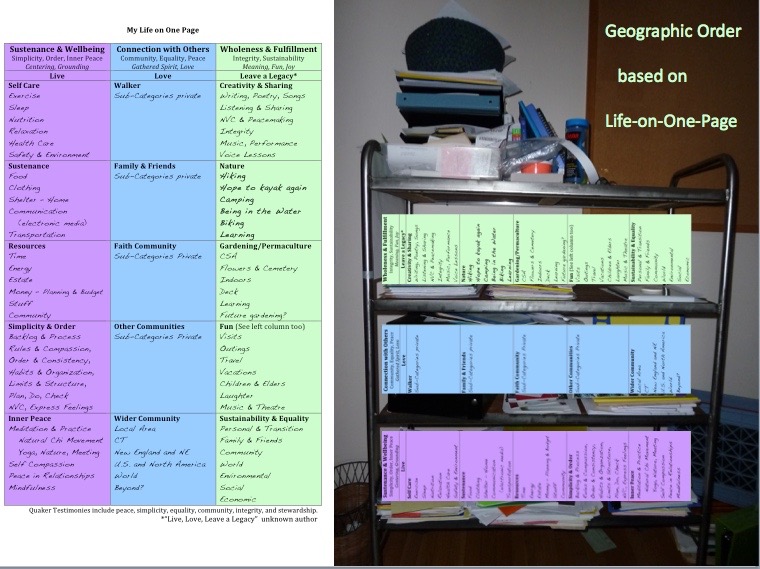
For my-life-on-one-page, I name three “dimensions” of my life: Wellbeing, Connection, and Fulfillment. Each dimension gets a shelf on my cart, with Wellbeing being the foundation at the bottom, Connection being the middle shelf, and Fulfillment being the third one up from the bottom. The top shelf is a bonus shelf, and I use it differently at different times. Sometimes the bonus shelf holds piles of unsorted papers…
The shelves on the cart above are deep, so it is easy to fit at least five piles of papers and objects onto each shelf; the five piles correspond to the five categories under each of the three dimensions on my Life on One Page, which is shown graphically in the photo above right. (A whole life cannot fit onto one cart or set of shelves, so there will need to be more posts…)
At first, I had to refer to my-life-on-one page frequently as I brought more order to my chaos, but over time, I memorized the 15 categories, and they are second nature to me when I “file” stuff on shelves, tables as I sort, file drawers, and on my computer. I even store stuff on shelves in my basement according to My Life on One Page.
NOTE: ALTHOUGH THE OUTCOMES OF RESPONSIVE-DOMINANT PROCESSES CAN APPEAR SIMILAR TO THE THE OUTCOMES OF THE ORGANIZATIONAL STYLE OF SYSTEMATIC-DOMINANT THINKING, THE UNDERLYING COGNITIVE PROCESSES ARE DIFFERENT. THERE IS NO NEED FOR “CREATIVE TYPES” TO REJECT METHODS THAT RESULT IN MORE ORDER. I FIND IT IS NOT PAINFUL TO DO THINGS THE WAY I AM DESCRIBING, THOUGH IT WAS PAINFUL TO KEEP FAILING AT DOING THINGS THE WAY I WAS TAUGHT BY SYSTEMATIC-DOMINANT THINKERS. BOREDOM IS MY ENEMY, AND THIS APPROACH TO BEING ORGANIZED KEEPS BOREDOM AT BAY. ALSO, KEEPING THINGS IN PLAIN SITE TO CUE ACTION IS IMPORTANT TO MY “SUCCESS.”
Once you have your own Life-on-One-Page, whether on paper or in your head, and whether in words or images, you will be able to organize spaces to store items by category that is customized to your own life.
(You don’t need to follow my plan at all. For some ideas about creating your own Life on One Page please see the post “Yikes! Time for a Better Life?”at this link: How to create your own version of “My Life on One Page”).
THE BEAUTY OF IT: Whenever things feel out of control, and there is no place to work, or I can’t find something important, I decide whether to clear a space by piling things up on a table or the bonus shelf, or by sorting items onto the cart into their respective categories. Either way, it’s better than just pawing through piles of stuff, increasing the overall chaos. When I find what I need, including an open surface to work without distraction, I know that any sorting I did will keep moving me in a good direction, until eventually, it will all be sorted, and I’ll have a new way to work.
And, well, ahem. The work space may pile up early and often for quite some time as habits are changed gradually. So when this happens, stuff can either be quickly sorted into categories on the responsive-storage shelves, or can be piled carefully on a card table, or “bonus shelf” for later sorting. As long as the overall process is improving, it’s all good.
Also, when stuff comes into the house (or workplace for those still able to work), it can go directly into the respective geographic location on the shelves where it is visible. When it comes to health care or “money” (bills, accounts, statements, etc.), I can grab a big pile from the cart at any time, sort items using the kitchen island or card table, and file stuff, returning the rest that is still pending to the cart.
The only stuff that gets filed out of site is stuff that is essentially archival, like old bills, tax records from past years, documents like birth certificates, passports, health records, etc. If something is pending, I either leave the item on the cart where I can see it in the pile, or a “cue” to that item on the cart or elsewhere (more about “cues” later).
Once you have your Life on One Page, whether in images, writing, or imagination, it can be used to organize stuff visually, geographically, chronologically, and kinesthetically. The same categories can be used in file drawers, computer files, attics, basements, studios, garages, and other spaces – topics for another day.
(Side Note: It has helped me tremendously to develop a new habit of always clearing a space with minimal visual distraction to do any activity.) (more about this in a later post)
I am not a health-care professional, and am sharing ideas, not making any promises of safety or assistance.
Words and images copyright 2016 Brenda Roberts Shaw , Mansfield Center, CT, USA

 Brenda Roberts Shaw